The Dinosaurs Are Comfortable.
A state of real estate tech in 2026.
Veer Patel

It's 6:47 PM on a Thursday in October, and a broker in Hanover, New Hampshire, is sitting in her car in the driveway of a colonial that just sold itself.
The buyers loved the kitchen. They loved the screened porch. They loved the way the late light came through the dining room windows, and twenty minutes into the showing, the husband said the words every agent waits to hear: what would we need to do to get this?
What she needed to do, in that moment, was draft a purchase and sale agreement. The buyers were standing on the porch. The sellers were 3 miles away, finishing dinner. Every variable required to write the contract — the property address, the deed reference, the tax map, the disclosures, the seller's name as it appeared on the title — all scattered across different tabs.
Instead of closing the house on the spot, she had to drive back to the office and start digging for the files. By the time she opened her laptop, found the property in Dotloop, copied the address into the form, opened a separate tab to look up the deed at the registry, opened a third tab to find the tax assessment, and started filling in the buyer's information line by line, it was past eight o'clock. She reviewed the contracts and sent them at 9:14 PM.
The buyers signed the next morning at 11:00 AM. The deal closed. Nothing went wrong.

Except the fact that 2½ hours had passed between the questions and the contract, and somewhere in that gap was a window that has been studied repeatedly in real estate and in every industry adjacent to it: clients are dramatically more likely to commit to a decision in the first 15 minutes after they make it emotionally. By the time she got the contract drafted, those 15 minutes had ended 145 minutes ago.
This is not a story about a bad broker. She is, in fact, an excellent one, one of the top producers in her market. This is a story about the antiquated software she was using, and the software every other broker in America was using that night, and why none of it has meaningfully changed in over a decade.
The Two Doors

If you are an agent in the United States today, odds are you use a platform called Dotloop, or maybe you use Skyslope, which overpromises and underdelivers.
Dotloop was founded in 2009 in Cincinnati. It was acquired by Zillow in 2015 for $108 million. By industry estimates, it now handles close to half of all U.S. real estate transactions, somewhere in the neighborhood of 1.5 million deals a year flow through it. The platform competes with Skyslope, Lone Wolf's Transaction Desk, and a handful of smaller players, but Dotloop has a firm grasp on the market. Most American brokerages either run directly on it, or run on something that looks almost identical to it, but almost all of them have something to say about what they are using.
The brokerage that doesn't use Dotloop probably uses Lone Wolf. Lone Wolf is a Canadian company that owns Lone Wolf Back Office, the back-office accounting system that runs a substantial portion of American real estate firms. It also owns Transaction Desk and a portfolio of acquired tools, having spent the last decade rolling up smaller players. Together, these companies cover the overwhelming majority of American transaction management.
They are not bad companies. They are, by most operational measures, successful ones. Lone Wolf is private-equity owned and has been steadily profitable for years; Dotloop, inside Zillow, generates real revenue. Their executives are competent. Their sales teams close deals. Their customer success organizations answer the phone.
What they do not do, and have not done in any meaningful sense for over a decade, is ship.
When the roadmap stopped.
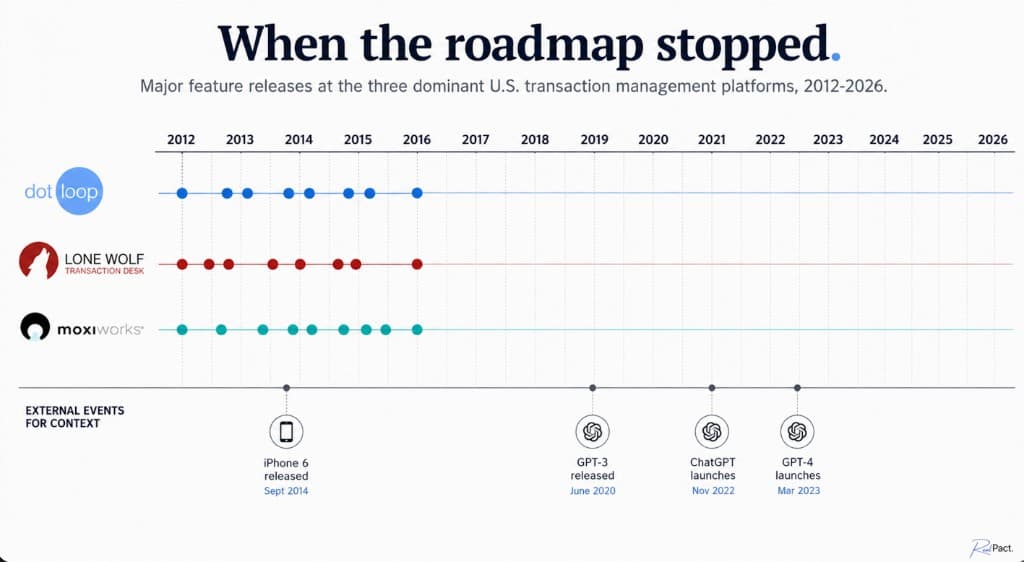
A reader could quibble with what counts as a “meaningful” release; every platform ships small updates, UI refreshes, bug fixes, a quarterly newsletter announcing minor improvements. What a reader cannot reasonably dispute, looking at any of these three platforms over the last twelve years, is that the rate of substantive product change has collapsed. The interfaces look almost exactly as they did in 2014. The workflows are unchanged. The fields a broker fills out manually today are the same fields a broker filled out manually a decade ago, in the same order, in the same boxes, with the same lack of help from the software they pay thousands of dollars annually to use. Nothing fundamentally has changed.
In the same window, the world outside this category has been transformed. The iPhone got Face ID, then satellite messaging, then on-device AI. Adobe shipped generative fill. Figma shipped real-time multiplayer. Stripe rebuilt international payments. Notion replaced corporate wikis. ChatGPT happened. None of it touched real estate transaction software, because the companies that own real estate transaction software did not need to ship anything to keep their revenue.

This is the structural fact that explains everything else. Dotloop and Lone Wolf are not failing. They are winning. Their customers cannot easily leave; the switching costs are enormous, the training is significant; the brokerage IT director who picked the platform in 2014 still works there and does not want to admit it was a mistake. Their pricing is sticky. Their contracts auto-renew. Their margins are healthy.
Stagnation, in this industry, is a business model. The dinosaurs are not extinct. They are profitable.

“We've been on Dotloop for nine years. I don't love it. Nobody loves it. But the thought of moving 280 agents to something else gives me a headache.”
The Bargain

The question worth asking is why agents settle for less.
The simplest answer is the most accurate one: most of them have never seen anything else. The median age of a Realtor in the United States is 55. A 55-year-old agent first closed a transaction on paper, then transitioned to PDFs around 2010, and has been on whatever digital platform their brokerage chose somewhere between 2014 and 2018. They do not benchmark their software against modern tools. They benchmark it against the manila folder it replaced, and by that comparison, Dotloop was a miracle.
The younger agents, the ones who entered the industry after 2018, who use ChatGPT for listing descriptions and Canva for marketing flyers, know that this software comes straight out of a horror film. They complain about it constantly in private Facebook groups and Slack channels. But they were not the ones who chose the software. The brokerage chooses to silo this younger generation of agents into software that was released before they even graduated high school. And the brokerage, which is being run by someone older and “wise,” has every reason to keep choosing what it already chose.
Then there is the structural lock-in. The MLS that controls each regional market integrates with a specific small set of approved platforms. The forms libraries are legally compliant with the necessary state-specific contracts every transaction requires. Switching transaction management software in real estate is not like switching CRMs in a SaaS company. It is closer to switching banks: theoretically possible, practically painful, and almost no one bothers.
The result is a market that does not function like a market. The customers are unhappy but locked in. The vendors are profitable but unmotivated. Younger agents who would pay for better tools cannot route around the brokerage's choice, and brokerage owners are not the ones doing the data entry, so they do not feel the pain that would justify the change. Everyone is uncomfortable, but the discomfort is distributed in such a way that no one has the leverage to fix it.
This is the bargain American real estate has made with its software vendors: in exchange for stability and integration, it accepts that the tools will not improve.
The cost of 15 minutes.
The actual cost of this bargain, measured in human hours, is staggering.
A typical residential agent in the United States closes between 40–60 transactions per year. Each transaction involves somewhere between 8–15 documents — listing agreements, purchase and sale contracts, addenda, disclosures, lead paint forms, you know the drill. Most of these documents share fields. The seller's name appears on the listing agreement, the purchase and sale, the deed reference, and the disclosures, typed manually, four times, into four different fields because this software doesn’t want to create an autofill feature.
30–40
minutes per contract on manual data entry
200+
hours per agent, per year, lost to retyping
5
forty-hour work weeks returned
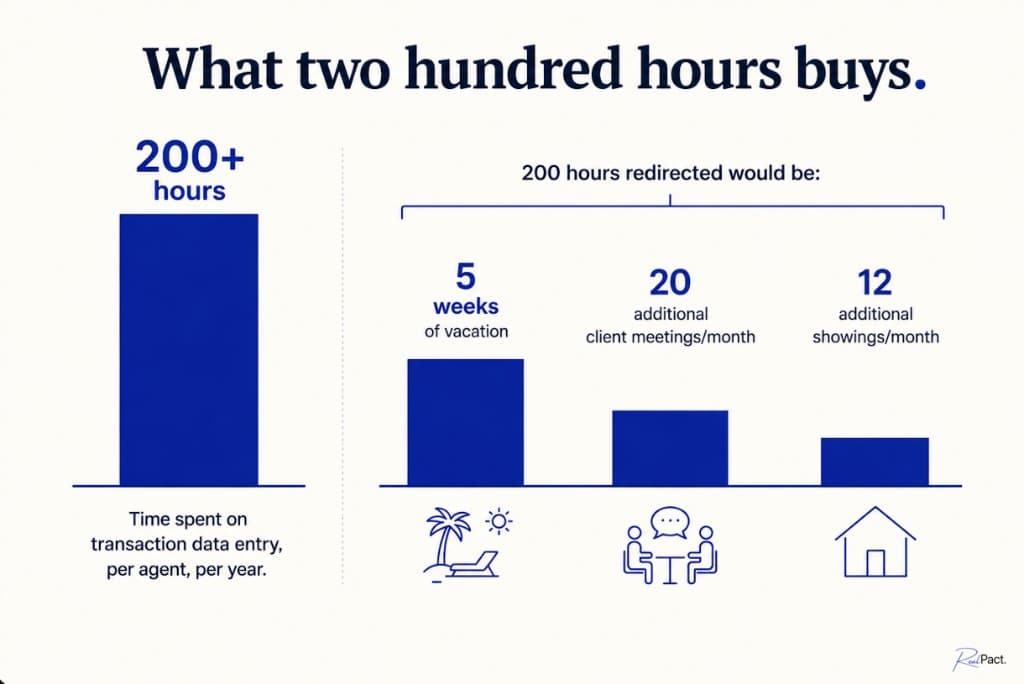
The published industry estimates put manual data entry at 30–40 minutes per contract. Across a year, for a working agent, the math compounds quickly. Over 200 hours. The equivalent to 5 forty-hour work weeks, spent on data entry that the software theoretically exists to eliminate.
But the hours understate the real cost, because the most expensive thing about the current workflow is not the time spent. It is the time missed.
Every experienced agent has a version of the story that opened this article. The buyer is excited. The seller is reachable. The market is moving. And the contract is back at the office, locked behind a series of manual lookups in five separate systems, none of which talk to the others. That 15-minute window — the moment when emotional commitment is strongest, and the deal is most likely to come together — closes while the agent is frantically searching for the parcel ID in some AxisGIS system.
There is no public dataset that captures how many transactions are lost to this delay. There cannot be one, because the deals that fall apart in those gaps simply do not happen — there is no record of them, no signed contract, no MLS entry. They are absent. But every senior broker in America has watched it happen, and the cumulative cost across the industry, measured in deals not closed, is almost certainly larger than the cost measured in hours wasted.
The current generation of transaction software was built in an era when the answer was “we'll get to that when we're back at the office.” That era is over. Buyers expect the contract on the porch. Agents who can deliver it will outcompete the ones who can't. The software has not caught up.
Today.
It is fair, at this point, to ask why nothing has changed if the problem is so obvious.
The honest answer is that until recently, the technology to fix it did not exist. The bottleneck in real estate transactions is not user interface design or workflow logic. It is the fact that the data lives in dozens of fragmented systems — county registries, MLS feeds, tax assessor databases, GIS portals, attorney records — most of which are not designed to talk to each other, many of which are public but not structured, and almost none of which expose modern APIs.
A Dotloop engineer in 2016 could not have built what real estate actually needed, because the underlying technology was not capable of it. Pulling structured data from a county deed registry required either a manual lookup or a brittle scraper that broke every time the county updated its website. Cross-referencing that data with tax assessment records required another scraper. Filling the resulting data into a contract template required hard-coded mappings that broke every time a state association updated a form.
What changed, in the last 24–36 months, is that all three of these problems became tractable simultaneously. Large language models can extract structured data from unstructured government websites. Computer vision can read scanned tax cards and historic deeds. Voice models can let an agent dictate a contract from the porch of a house and have it draft itself before they get to the car. The unit economics that made real automation impossible in 2018 are different in 2026.
This is not speculation. It is the reason new entrants have begun appearing in the category for the first time in a decade — a sign the moat the incumbents have been sitting behind has started to evaporate. The companies that invested in modern infrastructure during the AI inflection are now building tools that do, in seconds, what Dotloop has been asking agents to do manually for ten years.
The dinosaurs do not yet feel the change. They will.
The next decade.
In the next decade, the workflow described in the opening of this article should not exist. It will be replaced by a younger agent who will speak into their phone,
“draft a purchase and sale for the buyers we just showed”
and by the time they return to their office, the contract will be drafted, the property data pulled, the deed referenced, the tax map filled in, the disclosures attached. They will review it on the screen, make whatever changes the specific deal requires, and send it for signature before the buyers have left the driveway. The 15-minute window will close on a signed contract instead of a missed opportunity.
The brokerage of 2036 will run on roughly a tenth the operational headcount it runs on today. The transaction coordinator role, which exists almost entirely to compensate for software that cannot do its job, will not exist in its current form. The data entry hours will be returned to the agents, and the agents who use those hours to be in front of clients will outproduce the ones who do not.
The platforms that survive this transition will be the ones that began rebuilding their infrastructure in the early 2020s. The platforms that did not will discover, eventually, that revenue stickiness is not the same as a moat. Switching costs erode the moment the alternative becomes obviously better, and at some point, that obviousness arrives all at once.
The dinosaurs are comfortable. They have every reason to be. They’ve been comfortable for over a decade, and the discomfort is borne almost entirely by their customers.
This publication exists, in part, to document what happens next. What the next generation of transaction management will be like. And it will start here.


Closing is a free bi-weekly publication on the business of American real estate, brought to you by RealPact. Each issue covers brokerages, platforms, deals, and dinosaurs. We do not believe transaction management software has to be boring, ugly, or stuck in 2014, and we are betting our company on it. The next issue arrives in two weeks.